

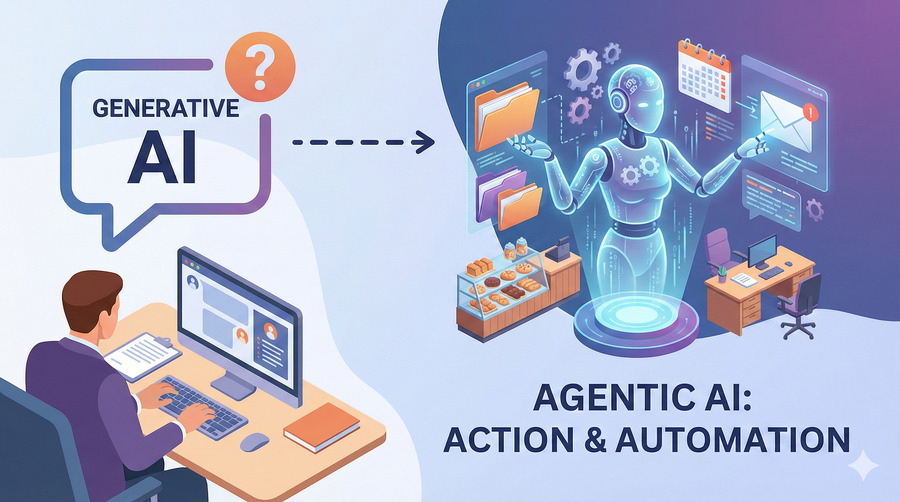
If you used ChatGPT or Gemini in 2025, you likely treated it like a high-priced consultant. You asked it a question, it gave you a good answer, and then… nothing happened. You still had to copy that text, paste it into an email, open your CRM, and hit “send.”
The consultant gave advice, but you did the work.
In 2026, things will be changing. The era of the “Chatbot Consultant” is ending. We are entering the age of Agentic AI—AI that acts more like a smart, independent intern rather than a consultant.
Imagine an AI that doesn’t just write the email but sends it. An AI that doesn’t just suggest a meeting time but accesses your Google Calendar, coordinates with the client, and books the slot. An AI that logs into your inventory system, notices you are low on stock, and drafts a purchase order for your approval.
For small business owners, this is not science fiction. It is the difference between generating text and executing tasks. And it is the single biggest leverage point for your business this year.
What is Agentic AI? (And How is it Different?)
To understand why this matters, we need to distinguish between the two dominant forms of AI today.
1. Generative AI (The “Creative”)
Generative AI (like ChatGPT-4o or Claude 3.5) creates content. It predicts the next word in a sentence or the next pixel in an image.
- Input: “Write a thank you note to my client.”
- Output: A text draft of a thank you note.
- Limitation: It is trapped inside the chat box. It cannot “see” your other software or “touch” your business data.
2. Agentic AI (The “Doer”)
Agentic AI introduces two essential dimensions: perception and action. It can perceive its environment (your inbox, your CRM, your website) and take action to achieve a goal.
- Goal: “Ensure all new leads get a meeting booked within 24 hours.”
- Process: The Agent checks your form submissions -> Scans your calendar -> Emails the lead -> Follows up if they don’t reply -> Books the meeting.
- Result: You wake up to a full calendar without lifting a finger.
The Agentic Loop
At Haketi, we explain the “Agentic Loop” to our clients using three steps:
- Trigger: The agent detects a signal (e.g., an incoming email, a database change, a specific time of day).
- Reasoning: The agent “thinks” about the best course of action based on the rules you’ve given it.
- Action: The agent uses “tools” (API connections) to execute the task in the real world.
3 Real-World Use Cases for Small Businesses
You don’t need to be a Fortune 500 company to deploy agents. In fact, small businesses benefit more because agents act as the affordable staff multiplier you’ve been waiting for.
1. The 24/7 Receptionist (Service Businesses)
The Problem: You run a roofing or plumbing company. A homeowner discovers a leak at 11:00 PM and visits your site. They want help now, but your office is closed. They fill out a contact form, but by the time you call them back at 9:00 AM, they’ve already hired a competitor who answered the phone.
The Agentic Solution: An AI Agent embedded in your website doesn’t just say “Leave a message.”
- It asks the user about the leak severity.
- It checks your field team’s Google Calendar for tomorrow’s availability.
- It offers the customer a specific 8:00 AM slot.
- The Action: If the customer says “Yes,” the agent books the appointment, sends a confirmation SMS, and alerts your crew—all while you sleep.
2. The Sales Hunter (B2B & Professional Services)
The Problem: Your law firm or design agency needs more leads, but your partners are too busy billing hours to do prospecting.
The Agentic Solution: You set up a “Sales Development Representative” (SDR) agent.
- The Trigger: You give the agent a list of local businesses or a LinkedIn search parameter (e.g., “CTOs in Lafayette”).
- The Reasoning: The agent visits their websites to qualify them (e.g., “Do they have an outdated website?”).
- The Action: It drafts a highly personalized connection request or cold email referencing their specific situation and saves it as a “Draft” in your outreach tool for you to approve.
3. The Order Manager (E-commerce)
The Problem: 40% of your customer support emails are simply “Where is my order?” Answering these takes hours of manual lookup.
The Agentic Solution: A Customer Support Agent connects your chat widget to your WooCommerce or Shopify backend.
- The Trigger: Customer asks, “Status of order #1234?”
- The Action: The agent logs into the database, retrieves the tracking URL from FedEx, and replies: “Hi Sarah, your package is currently in Baton Rouge and is estimated to arrive tomorrow. Here is the link.”
- Zero human intervention required.
The Toolkit: How to Build Your First Agent Today
You are likely wondering, “This sounds expensive.” It isn’t. The tool landscape has exploded with “No-Code” and “Low-Code” options that put this power in the hands of small business owners.
For the “DIY” Business Owner: Lindy & Zapier Central
If you can use a spreadsheet, you can use these tools.
- Lindy.ai: This platform lets you create an “employee” in minutes. You can build a “Medical Receptionist” or a “Recruiter” by simply selecting their skills. Lindy handles the integrations naturally.
- Zapier Central: You likely already use Zapier to move data. “Central” acts as a brain that sits on top of your Zaps. You can talk to it: “Show me the last 5 leads from Facebook and draft an email to them.”
For Complex Workflows: n8n
For businesses that need strict data privacy or complex routing (e.g., “If the deal is over $10k, alert the CEO; if under $10k, alert the Sales Manager”), n8n is the industry standard. It is node-based, visual, and incredibly powerful.
The “Human-in-the-Loop”: A Safety Warning
With great power comes great responsibility. The biggest fear clients have regarding Agentic AI is: “What if it goes rogue?”
What if your AI sales agent promises a discount you can’t honor? What if your support agent gets angry at a rude customer?
The solution is the Human-in-the-Loop (HITL) protocol. When we design agents for clients, we implement “confidence thresholds” and permissions:
- Read-Only Mode (Level 1): The agent can look at data and answer questions, but cannot change anything in the database.
- Draft Mode (Level 2): The agent can do the work (write the email, create the invoice) but cannot send it. It saves it as a draft and alerts a human to click “Approve.”
- Autonomous Mode (Level 3): Once the agent has proven itself over 50-100 interactions, we untether it to act fully autonomously for routine tasks, escalating only complex issues to humans.
Hidden SEO Benefits: Why Google Loves Agents
You might think Agentic AI is purely about operations, but it has a massive downstream effect on your SEO rankings.
- Dwell Time & Engagement: An interactive agent that helps users do things keeps them on your site longer. Google notices when users stay on your page for 5 minutes solving a problem vs. bouncing in 10 seconds.
- User Signals: If a user solves their problem instantly (e.g., booking an appointment), they are less likely to return to the search results to click on a competitor. This “satisfied user” signal is a ranking factor.
- Fresh Content: Agents can automatically summarize your latest case studies or projects and publish them as “Recent Updates” on your site, keeping your domain active and crawled frequently.
Frequently Asked Questions (FAQ)
Conclusion
The window of opportunity is open. Right now, most of your competitors are still trying to figure out how to write better blog posts with ChatGPT. They are using AI to talk. By deploying Agentic AI, you can use AI to act.
Whether it’s a 24/7 receptionist that never sleeps, a sales agent that never stops prospecting, or an operations agent that eliminates data entry, these tools are the ultimate equalizer for small businesses.
You don’t need a billion-dollar budget. You just need the right blueprint.
Ready to hire your first AI employee? At Haketi, we don’t just design beautiful websites; we build intelligent ones. Contact us today for a workflow audit, and let’s identify the first task we can take off your plate forever.