

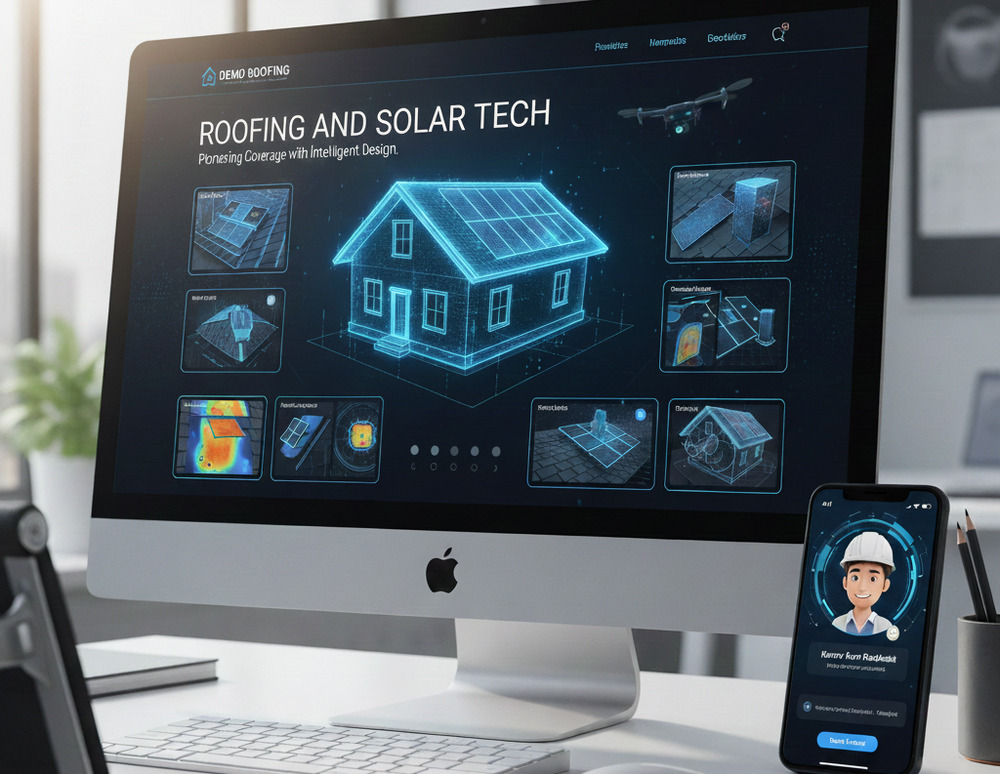
Did you realize a great user experience on your roofing website could increase your conversions by as much as 400 percent? That is an enormous return! The internet has completely changed the roofing business, specifically how property owners find and choose contractors. A professional website is a must for a roofing company that wants to attract new customers. As technology moves forward quickly, your website must keep up. We will look at the most important roofing web design trends and technologies that will determine success in the coming years.
Prioritizing User Friendliness
We have seen a big change in how web design is done: the user is the most important thing. It’s not just about appearances; it’s about ensuring every visitor has a smooth, informative, and engaging experience. Understanding what your target audience wants and expects is extremely important. Your website design has to be carefully made to meet those specific needs.
Mobile First
Google now puts the mobile version of your website first when deciding search rankings. This highlights how important it is to ensure your website operates perfectly on smartphones and tablets. It is more than simply responsive design; it is about creating specifically for mobile users. Concentrate on making navigation simple, making sure buttons are easy to tap and ensuring quick loading speeds on mobile networks.
We know of roofing companies that have lost good leads because their mobile sites did not work well. A smooth mobile experience is a must.
Fast Loading Times
How fast your website loads has a big effect on search engine rankings. People expect things to load right away, and Google does not like slow websites. Image optimization and reducing code size are very important. Think about using content delivery networks, or CDNs, to make loading times faster. There are many free online tools that can check how fast your website is and suggest ways to improve it. A fast website makes users happy and improves search engine visibility.
Accessibility For Everyone
Accessibility means creating websites that everyone can use, even people with disabilities. This involves adding alt text to images, using high-contrast color schemes, and ensuring keyboard navigation is possible. Making accessibility a priority is not only the right thing to do, it also helps your SEO. Google likes websites created for inclusivity.
Visuals That Grab You
Visual appeal is important. A website that looks good can immediately grab visitors’ attention and create a lasting impression. These visual trends are getting more popular and can greatly improve how visible your roofing website is.
Good Photos and Videos
Generic stock photos are not good enough anymore. Put money into professional, high resolution photos and videos that show off your roofing skills. Showing your work with great visuals builds trust with potential customers. Photos showing before and after are especially effective.
3D Graphics and Animations
3D graphics and animations add excitement and depth to your website. Imagine using 3D roof models to show different roofing styles or animations to explain complicated roofing processes. These things can make users more interested and help them remember your brand.
Keep it Simple
Minimalist design is becoming more popular. It focuses on clean lines, simple layouts and lots of white space. This makes users pay attention to what is important and creates a feeling of elegance and calm. White space is not just empty space; it is a design element that makes things easier to read and more visually pleasing.
New Technologies
Technology is always changing how roofing websites look and what they can do. Using these new things can give you an advantage.
Artificial Intelligence (AI)
AI is already having a big effect on web design and marketing. Here is how AI can make your roofing website better:
- AI Chatbots: Give customers instant support and answer common questions all the time, allowing your team to focus on more difficult things.
- Personalized Content: AI can look at user data to change website content and offers to fit what each person likes. As an example, if a user is interested in shingle roofs, AI can make shingle related content show up first on future visits.
- Predictive Analytics: AI can look at website traffic and user behavior to predict which potential customers are most likely to become paying clients, helping you make the most of your marketing money.
Virtual Reality (VR)
VR offers exciting possibilities for roofing websites. Think about letting potential customers take a virtual tour of a house with a new roof, seeing different roofing styles and colors in a realistic way. VR technology is still new, but it could completely change how roofing services are marketed.
Augmented Reality (AR)
AR lets users put digital images on top of the real world using their smartphones or tablets, allowing them to see how a new roof would look on their current home. Users simply point their device at their house, and a virtual roof appears on the screen, offering a more realistic experience than regular 2D images.
Progressive Web Apps (PWAs)
Progressive Web Apps, or PWAs, are web applications that act like native mobile applications. Users can install them on their devices, use them even when they are not online and receive push notifications. PWAs give a much better and more interesting user experience than standard websites. For roofing companies, this means potential customers can get to their website whenever they want, even without an internet connection.
Local SEO
Even a website that is designed perfectly will not work if potential customers cannot find it. Local SEO for roofing companies is extremely important because you are trying to attract local clients.
Google Business Profile
Your Google Business Profile, or GBP, is often the first thing potential customers see when looking for local roofing services. Make sure your GBP is complete, accurate and uses relevant keywords. Add good photos of your work and encourage happy customers to leave reviews. A GBP that is well managed can greatly improve your visibility in local search results.
We always tell our clients to actively manage their GBP and quickly respond to reviews, showing they care about customer satisfaction.
Local Keywords
Add local keywords throughout your website content, meta descriptions and title tags. Target specific cities and neighborhoods where you offer services. This will improve your website’s ranking in local search results. Instead of generic words such as “roofing contractor,” use keywords such as “roofing contractor [city name]” or “roof repair [neighborhood name].”
Local Citations
Local citations are mentions of your business name, address and phone number online. These citations prove to Google where your business is located and improve your local search ranking. List your business on trusted online directories such as Yelp, Angie’s List and HomeAdvisor. Consistency is important; make sure your information is the same across all online platforms.
Content Marketing
Content marketing means creating and sharing content that is valuable, informative and interesting to attract and keep customers. For roofing companies, this means creating content that teaches potential customers about roofing problems, solutions and best practices. Content marketing shows that you know what you are doing and builds trust, which ultimately generates leads and sales.
Blog Posts
Posting blog posts on your website regularly is a good way to share your knowledge with potential customers. You can talk about common roofing issues, discuss different roofing materials, give maintenance tips and report on industry news. Improve your blog posts with relevant keywords to improve their search engine ranking.
Case Studies
Case studies give detailed looks at your most successful roofing projects. They offer real proof of your skills and the value you give to customers. Include details about the problems you faced, the solutions you used and the results you achieved. Case studies are a great way to build trust and show that you are credible.
Infographics and Videos
Infographics and videos are interesting ways to simplify the communication of complicated information in a way that looks good. Create infographics that show different roofing types, common roofing problems or the benefits of regular roof maintenance. Make videos that show your team, your projects or give step by step tutorials for small roofing repairs. Visual content is more likely to be shared on social media, which expands your reach.
Social Media
Social media is a necessary part of any modern marketing plan. It can drive traffic to your website, increase brand awareness, and help you engage with potential customers.
Social Media Feeds
Show your social media feeds on your website to show your latest posts and updates. This keeps your website content new and interesting. Encourage visitors to follow you on social media to stay up to date on your latest news and promotions.
Social Sharing Buttons
Make it easy for visitors to share your website content on social media by adding social sharing buttons to your blog posts and other pages. This will make your audience bigger and bring more people to your website.
Social Media Advertising
Use social media advertising to target potential customers in your service area. Target your advertisements based on demographics, interests and behaviors. Run advertisements that promote your roofing services, special offers or upcoming events. Social media advertising can be a good way to reach a large audience and generate leads without spending too much.
Website Performance
Tracking and looking at your website’s performance is very important for knowing what is working well and what needs to be better. Use web analytics tools such as Google Analytics to watch website traffic, user behavior and conversion rates. Look at this data to find areas for improvement.
Key Metrics
- Website Traffic: How many people are visiting your website?
- Bounce Rate: What percentage of visitors leave your website after only seeing one page?
- Time on Site: How long do visitors stay on your website?
- Conversion Rate: What percentage of visitors do what you want them to do, such as filling out a contact form or asking for a quote?
- Lead Generation: How many leads are coming from your website?
A/B Testing
A/B testing, also known as split testing, means comparing two versions of a webpage to see which one works better. Try different headlines, images, calls to action and layouts to find out what users prefer. A/B testing can improve your website’s ability to turn visitors into customers.
The Future
The future of roofing websites depends on making the user experience a priority, using new technologies and focusing on local SEO. Roofing companies that use these roofing web design trends and technologies can create websites that bring in customers, generate leads and drive sales. Always improving, adapting and giving value to your audience is key.