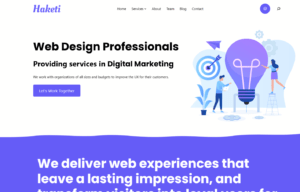


In the world of web development, the old adage “buy nice or buy twice” has never been more accurate. For a business owner, the appeal of a $500 or $1,000 website is understandable. However, there is a fundamental difference between a professional web designer and a pretender. Understanding these differences is the key to protecting your brand’s reputation and your bottom line.
1. The “Pretender” vs. The Professional
The market is currently flooded with “pretenders”—individuals who have learned to use a basic page builder but lack the deep technical knowledge required to build a high-performing business asset.
- The Professional Approach: A professional agency like Haketi starts with strategy. We analyze your competitors, identify your target audience’s pain points, and map out a user journey that leads to conversions. We write clean code, optimize for every screen size, and ensure the site is accessible to all users.
- The Pretender Approach: A pretender starts with a template. They swap out the logo and colors, slap in some generic stock photos, and call it a day. These sites often look “fine” on the surface but are hollow underneath. They lack the structural integrity to rank on Google or handle a surge in traffic. There are a lot of things behind the scenes for a well-designed website like information architecture, accessibility, usability testing, responsive web design, web performance, modern web standards, and many others.
2. The Reputation Killer: “Ugly” is More Than Skin Deep
When we talk about “ugly” design, we aren’t just talking about bad color choices. In 2026, an ugly design is any design that looks outdated, cluttered, or unprofessional.
Your website is often the very first interaction a potential customer has with your brand. Research shows that it takes a user approximately 50 milliseconds to form an opinion about your website. If your site looks like it was built in 2010, users immediately project that lack of quality onto your services or products.
A cheap designer often fails at:
- Visual Hierarchy: They don’t know how to lead the eye to your “Call to Action” buttons.
- Typography: They use hard-to-read fonts or inconsistent sizes that create “visual noise.”
- Mobile Responsiveness: A professional site is built mobile-first. A cheap site is often “shrunk” to fit a phone, resulting in buttons that are too small to click and overlapping text.
3. SEO: The Invisible Victim of Low-Cost Design
This is where the true cost of cheap design reveals itself. You can have the most beautiful website in Louisiana, but if it isn’t built for SEO, it is essentially a billboard in the middle of the woods.
Cheap web design services almost always ignore Technical SEO. They use “bloated” code and heavy, unoptimized images that slow your site down. In 2026, Google’s Core Web Vitals are a primary ranking factor. If your site takes more than two seconds to load, Google will bury you on page five of the search results.
Furthermore, pretenders rarely understand Site Architecture. They create “flat” sites with no internal linking strategy, making it impossible for search engine crawlers to understand which pages are the most important. At Haketi, we build SEO into the very first line of code, ensuring that your site is “Google-ready” from the moment it launches.
4. Security Risks and the “Broke” Website
Cheap designers often use “nulled” or free versions of premium plugins to keep their costs down. These are notorious for having backdoors that hackers use to inject malware into your site.
Imagine a potential client visits your site only to be greeted by a “This site may be hacked” warning from Google. The damage to your reputation is instantaneous and often permanent. Professional designers use licensed, high-security tools and provide ongoing maintenance to ensure your software is always up to date.
Breaking Down the Investment: 2026 Price Reality
To help you budget effectively, here is what the professional landscape looks like for small to mid-sized businesses in 2026.
| Feature | Cheap “Pretender” ($500 – $1,500) | Professional Agency ($10,000+) |
| Strategy | None; “Just tell me what you want.” | Deep discovery, competitor & user intent analysis. |
| Design | Generic, overused templates. | Bespoke, brand-aligned custom UI/UX. |
| Speed | Slow; bloated code and unoptimized assets. | Blazing fast; built for Core Web Vitals. |
| SEO | None or “Plugin-only” (surface level). | Full technical SEO and keyword architecture. |
| Ownership | Often held hostage by the designer. | Full ownership of all assets and code. |
| Longevity | Needs a total rebuild in 12 months. | Scalable foundation that grows for years. |
Content Optimization Guidance for Your Next Project
If you are currently looking to audit your own site or are planning a redesign, focus on these critical on-page SEO factors:
Heading Structure
Your headings (H1 through H6) should act as an outline for the page. Use only one H1 per page, and ensure it contains your primary keyword.
- Correct:
<h1>Professional Web Design Services in Louisiana</h1> - Incorrect:
<h1>Welcome to Our Website!</h1>
Meta Descriptions
While not a direct ranking factor, a well-written meta description increases your Click-Through Rate (CTR). Keep it under 155 characters and include a clear call to action.
Internal and External Linking
A professional site links to its own high-value pages to distribute “link equity.” It also links out to authoritative external sources (like industry associations or government data) to build “Trust and Authority” in the eyes of search engines.
Troubleshooting: Is Your Current Site Hurting You?
If you suspect your current low-cost website is holding your business back, look for these three “red flags”:
- High Bounce Rate: If 80% or more of your visitors leave within seconds, your design is likely the culprit.
- No Organic Lead Flow: If you aren’t getting inquiries through your contact form despite having traffic, your user experience (UX) is failing.
- The “Google Search” Test: Search for your business by name. If you don’t appear in the top three results, or if your meta-information looks messy, your site’s technical foundation is broken.
The Haketi Philosophy: Investment vs. Expense
We encourage business owners to view a website as an investment, not an expense. An expense is money gone; an investment is money that works to bring more money back.
A $10,000 website that generates $100,000 in leads is infinitely “cheaper” than a $1,000 website that generates zero. When you hire a professional, you aren’t just paying for pixels on a screen—you are paying for a strategic partner who understands how to navigate the complexities of the 2026 economy.
Don’t let a “cheap” design ruin the reputation you’ve worked years to build. Choose experience, choose strategy, and choose a partner who values your business as much as you do.