

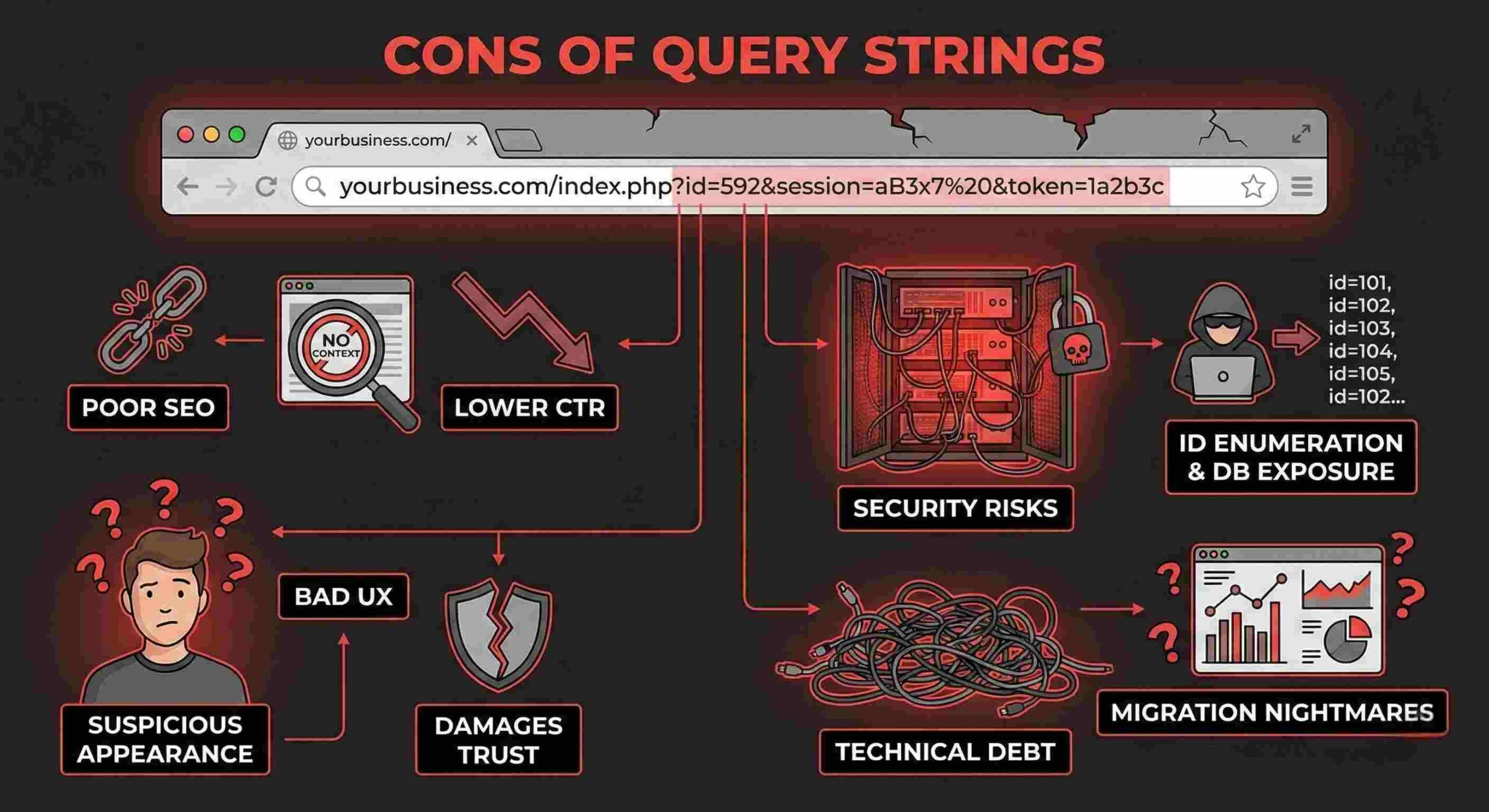
When you look at your website address bar, what do you see? Do you see a clear description of the page, like yourbusiness.com/services/plumbing-repair? Or do you see a string of confusing numbers and symbols, like yourbusiness.com/index.php?id=24?
If you are seeing the latter, you are using what is known as “query strings” or dynamic URLs for your primary navigation. While this method was standard practice in the early 2000s, today it is widely considered a liability.
At Haketi, we believe every part of your website should work toward your business goals. Relying on raw database IDs in URLs can harm your SEO, damage user trust, and pose security risks.
Search Engines Hate Ambiguity
Search engines such as Google operate efficiently by grasping the context of queries. They read the text on your page, the headers, the image tags, and crucially, the URL itself.
Missed Keyword Opportunities A semantic URL is a prime piece of real estate for keywords. If your URL is /services/commercial-roofing, you are telling Google explicitly what the page is about before it even crawls the content. A URL like ?id=592 tells Google absolutely nothing. By sticking with query strings, you are wasting one of the easiest opportunities to rank for your target services.
Lower Click-Through Rates (CTR) Your search ranking is not just about being on page one; it is about getting the click. When your site appears in search results, the URL is displayed below the title.
- Scenario A: Users see
.../best-pizza-recipe. They click because it confirms the result is relevant. - Scenario B: Users see
.../?id=592. They hesitate. It looks generic, automated, or perhaps irrelevant to their search query.
Lower click-through rates signal to Google that your page is not what users want, which can eventually drag down your rankings.
Usability and UX First
Websites are built for humans, not just databases. User experience (UX) is a significant factor in how modern web design is evaluated.
Unclear Context: Users want to know where a link leads before they click it. When you hover over a link on a modern website, the URL acts as a preview. If the URL is descriptive, the user feels confident navigating forward. If it is a string of numbers, they have no context.
Hard to Remember and Share: If a customer finds a helpful resource on your site, they can easily remember example.com/contact or example.com/pricing. They will never remember id=5. Friendly URLs make it easier for customers to return to your site directly or share the link with a friend verbally.
Suspicious Appearance: To non-technical users, URLs filled with symbols like ?, &, and = often look messy. In an era where phishing scams are common, users are trained to be suspicious of strange links. A clean URL looks professional; a messy one looks like broken code or a security risk.
Don’t Expose Your Skeleton
Using direct database IDs in your URL exposes the internal structure of your application to the public. This is often referred to by security professionals as “Insecure Direct Object References” (IDOR), though the risk varies based on implementation.
ID Enumeration (The “Guessing Game”): If a malicious actor sees profile.php?id=100, their first instinct is to change the URL to id=101, id=102, and so on. If your website permissions are not perfectly secured, this “enumeration” could allow them to stumble upon hidden pages, drafts, or even another user’s private data.
Database Exposure: Query strings often reveal that you are querying a database directly based on that specific number. This gives attackers a hint regarding your backend architecture, which can sometimes be the first step in attempting SQL injection attacks. While the URL itself isn’t the vulnerability, it provides a roadmap for attackers to test your defenses.
Future-Proofing Your Business
Finally, sticking to query strings creates a technical debt that becomes harder to pay off the longer you wait.
Migration Nightmares: If you ever move your site to a new system—for example, migrating from a custom PHP site to WordPress or Shopify—your new database IDs will likely be different. If your URLs rely on specific ID numbers (e.g., id=24), every single link on your site breaks during the migration. You would need to set up hundreds of complex redirects.
If your URLs rely on names (e.g., /about-us), the transition is often seamless because the page name remains the same on the new platform.
Analytics Confusion: When reviewing your Google Analytics or traffic reports, you want to see which content is performing best. It is incredibly difficult to analyze a report that is just a list of ID numbers. It’s essential to focus on the overall traffic generated by /spring-sale rather than getting caught up in specific metrics, like id=4055 receiving 50 hits.
Conclusion
Using URLs like index.php?id=5 is a practice from the early 2000s. It hurts your Google rankings because it hides the topic of the page from search engines, and it confuses visitors because they cannot tell what the link is before clicking. If a software or web development company built your website, contact them to request meaningful URLs. This is not professional in the mid 2020s and it hasn’t been recommended for at least 18 years.
Modern websites use “Friendly URLs” to build trust, improve visibility, and secure their data. If your website is still speaking in code, it is time to translate it into a language your customers—and Google—can understand.